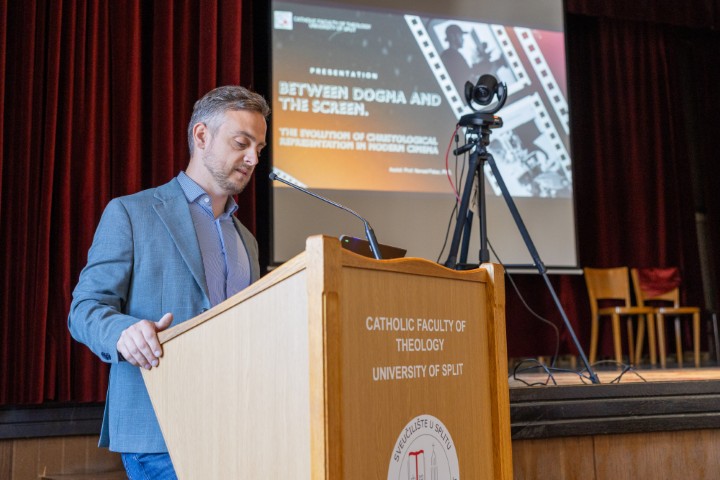
As part of the International Scientific Symposium “The Holistic Development of Young People in the Contemporary Educational Context: Challenges, Perspectives, and Spiritual Accompaniment,” held on 28 April 2026 at the Catholic Faculty of Theology, University of Split, Assistant Professor Nenad Palac, PhD, delivered a presentation entitled “Between Dogma and the Screen: The Evolution of Christological Representation in Modern Cinema.”
The presentation focused on analyzing changes in the cinematic representation of Jesus Christ, from traditional portrayals grounded in Christian dogma to contemporary allegorical, symbolic, and subversive interpretations. Drawing on theological-hermeneutical and film studies approaches, the research examined how film narrative, visual symbolism, and cultural context influence the understanding of Christ’s figure and the central Christian themes of suffering, sacrifice, and redemption. Particular emphasis was placed on the relationship between contemporary cinema and Christian dogma, as well as on the possibility of understanding the transformation of religious symbols in a secularized society as a form of implicit theology or as an indication of changes in the Christian symbolic imaginary.
In relation to the objectives of Work Package 3 (WP3) of the SVEJERKOV project, which focuses on digital communication, media culture, and the ethics of language, the presentation contributed to a critical reflection on film as a medium of communication that does not transmit religious content neutrally, but rather mediates, interprets, and reshapes it. Cinematic imagery, narrative, and symbolic language thus become means of communicating theological meanings, while also influencing how these meanings are understood in the public and cultural sphere. The analysis of various Christological representations enabled a critical examination of the responsibility of media creators and interpreters in shaping perceptions of religion, as well as of the relationship between the original meaning of Christian content and its contemporary media interpretations.
The contribution of the research to the objectives of WP3 is also reflected in its broader consideration of media literacy and the need for a critical assessment of how religious content is communicated in contemporary culture. This opens up opportunities for interdisciplinary dialogue between theology and media studies and for a deeper understanding of the communication processes through which religious meanings and value orientations are shaped, particularly within the digital and cultural environment that influences the formation of young people.