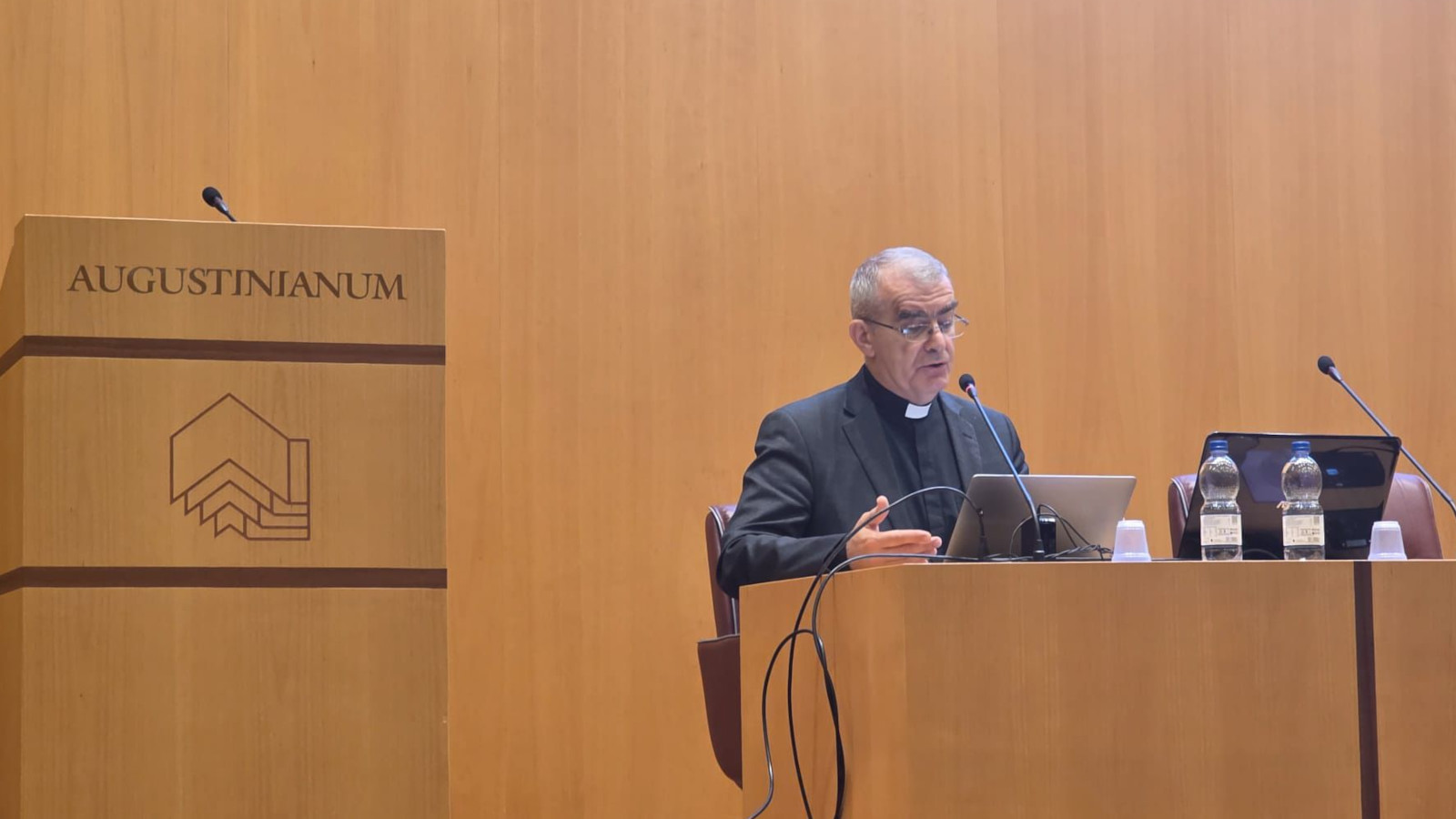
The LI. Incontro di Studiosi dell’Antichità Cristiana was held at the Pontifical Institute Augustinianum in Rome on 7 and 8 May, bringing together around 60 speakers from around the world. The conference’s general theme was Il cristianesimo, i popoli, le culture. Aspetti e problemi dell’inculturazione del cristianesimo nei primi secoli (I–IX). On Friday, 8 May, Prof. Ivan Bodrožić, PhD, delivered a lecture titled Il ruolo della figura di San Girolamo nella cristianizzazione e nell’inculturazione del popolo croato dal secolo VII, thereby presenting the results of the research he is conducting within the SVEJERKOV project (IP-UNIST-21) at the Catholic Faculty of Theology in Split.
Professor Bodrožić pointed out that the Christianization and inculturation of the South Slavic peoples in Western Illyricum were demanding and complex, markedly different from those that took place during Christianity’s first five centuries. Whereas in the early centuries the inculturation of Christianity presupposed a mutual relationship between the Church and the Empire, in the case of the Slavic peoples, including the Croats, the process was twofold yet one-sided. The Church of that time had to both preach the Gospel and transmit the Latin culture of the preceding society, since it could not count on the support of civil structures, which had by then collapsed under the pressure of barbarian peoples and tribes. However, since the majority of the Croatian population did not readily adopt the norms of Latin culture, the people continued to use the vernacular language, which in some circles cast doubt on the sincerity of their attachment to Christian orthodoxy. Nevertheless, thanks to the work of Saints Cyril and Methodius among the Slavic peoples, the Croatian people continued to use Old Church Slavonic in the liturgy and Glagolitic as their script. However, since the process of baptism — whose decisive turning point is marked by the baptistery of Prince Višeslav around the year 800 — was slow, as archaeology and toponomastics show, the faith did not easily penetrate all strata of the population. In everyday life, a certain degree of syncretism certainly existed, while on the other hand there was the obstacle of the Slavic language, unintelligible to the Western populations who at that time used Latin as a common language, but also as the liturgical language of worship. In this process, however, the Church agreed to the inculturation of the faith into the life of the Slavic people, allowing them the use of their own language. In order to remove all doubts regarding heresy or possible syncretism, it placed this process under the powerful patronage of St. Jerome, who in the meantime had been proclaimed the author of the Glagolitic script and the translator of the Bible into the Illyrian language. In this way he became the guarantor of orthodoxy in the process of Christianization, as well as of the integration of the Croatian people into the European cultural heritage.